%20(Stickers%20(Rectangle)%20(Landscape))_edited.jpg)


What Happens in the First Therapy Session

Updated: Sep 5
Starting therapy can feel like a big step.
Even when you know you want support, making the first appointment can bring up a surprising number of questions. What will the therapist ask? Will I have to talk about everything? What if I cry? What if I do not know what to say? What if I realize I am not comfortable with this therapist?
If you have never been to therapy before, the uncertainty can sometimes feel harder than the therapy itself.
At Authentic Living London, we want your first session to feel as comfortable and straightforward as possible. Whether you meet with your therapist in person or virtually, your first appointment is an opportunity to begin getting to know one another, talk about what brought you to therapy, and decide together what kind of support might be helpful.
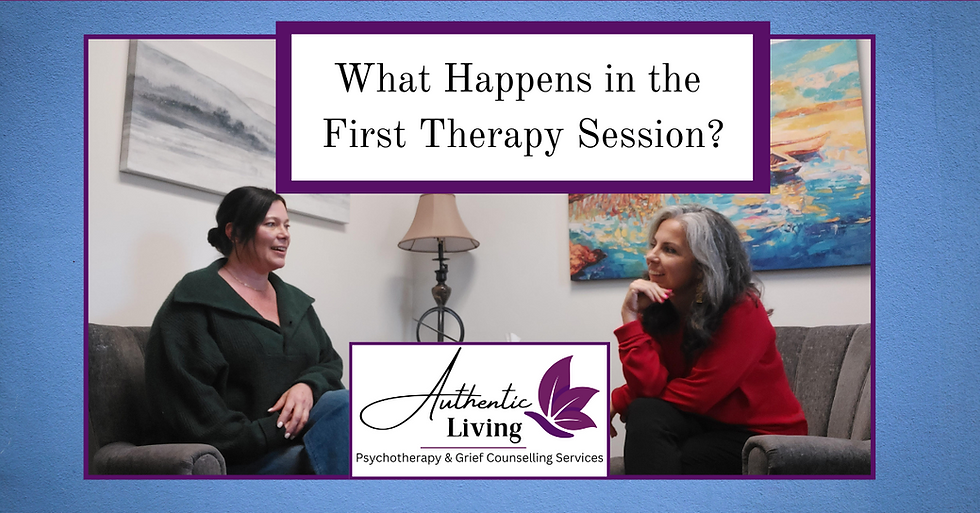
What Happens in a First Therapy Session?
Your first session is generally a combination of getting acquainted, gathering some background information, and beginning to understand what you would like help with.
There is no expectation that you will arrive with everything figured out.
Your therapist will likely ask questions about what has been happening in your life, what prompted you to reach out now, and what you hope might change. You may also discuss your personal history, relationships, previous experiences with therapy, current supports, and other information that could help your therapist understand the bigger picture.
Some of these questions may feel easy to answer. Others may take more time.
You are allowed to say, “I don't know,” “I'm not ready to talk about that yet,” or “I'm not sure how to explain it.”
Therapy is not an exam, and there is no perfect way to tell your story.
You Do Not Have to Tell Your Whole Story on Day One
One of the most common worries people have about starting therapy is that they will be expected to immediately talk about their most painful experiences.
That is not how therapy has to work.
Your therapist may ask about difficult experiences because understanding your history can be important, but the pace should be appropriate for you. A trusting therapeutic relationship develops over time.
Research on psychotherapy consistently points to the therapeutic relationship as an important part of treatment. A strong working alliance involves collaboration on the goals of therapy, agreement about how you will work together, and a sense that you and your therapist are working as a team (Flückiger et al., 2018).
That means your first session is not only about your therapist learning about you. It is also about you learning about your therapist.
You are noticing whether you feel listened to, respected, understood, and comfortable enough to continue.
You Can Talk About Why You Came to Therapy
Maybe you have a very specific reason for making the appointment.
You may be struggling with anxiety, depression, grief, trauma, relationship difficulties, burnout, a major life transition, or something that happened recently that you are having difficulty processing.
Or perhaps you simply know that something does not feel right anymore.
You do not need to have a diagnosis or a perfectly defined problem before seeking counselling. Sometimes the starting point is simply, “I am having a hard time, and I do not know what to do next.”
Your therapist can help you begin making sense of what is happening.
Your Therapist May Ask About Your History
Understanding your current concerns often requires looking at more than what happened this week.
Your therapist may ask about your family background, significant relationships, major life experiences, previous mental health treatment, physical or emotional health, and the supports you have around you.
They may also ask about what has helped you in the past and what has not.
This information helps your therapist develop a more complete understanding of your circumstances rather than treating a single symptom in isolation.
It is also part of determining whether the therapist's approach and the type of support being offered are appropriate for your needs.
What About Confidentiality?
Confidentiality is an important part of psychotherapy.
Your therapist will explain how your personal information is handled and the circumstances in which confidentiality may have legal or professional limits. These limits vary depending on the situation and applicable professional and legal requirements, so your therapist should explain them clearly rather than assuming you already know what they mean.
You should feel comfortable asking questions about confidentiality at any point.
If you are wondering whether something you share will remain private, ask.
A good therapeutic relationship includes being able to understand the boundaries of the relationship itself.
Will We Set Goals in the First Session?
You and your therapist will usually begin talking about what you would like to accomplish through counselling.
Sometimes the goal is very specific: perhaps you want to reduce panic symptoms, work through a particular loss, improve communication with your partner, or understand a recurring pattern in your relationships.
Other times, the goal is much less defined.
You might say, “I want to feel like myself again,” or “I want to understand why I keep reacting this way.”
That is enough to begin.
Goals can become clearer as therapy progresses. In fact, expecting someone to know exactly what they need before they have had an opportunity to talk through their situation can put unnecessary pressure on the process.
Your therapist may also discuss approaches that could be useful for your particular concerns. Therapy should be collaborative, with room for your preferences, questions, and feedback.
What If I Get Emotional?
You might cry.
You might feel nervous. You might laugh at an unexpected moment. You might find yourself talking more than you expected, or you might struggle to find the words.
All of those reactions can happen in therapy.
You are talking about things that matter to you, sometimes things that you have not talked about openly before. It is completely understandable for emotions to come up.
You do not need to apologize for crying or try to make your emotions more manageable for your therapist.
And if you do not feel emotional at all, that is okay too.
There is no “right” emotional response to a first therapy session.
What If I Do Not Like My Therapist?
This is an important question, and one that does not get discussed often enough.
Not every therapist will be the right fit for every person.
Therapeutic approaches, communication styles, personalities, areas of expertise, and expectations can all influence how comfortable you feel with a particular therapist. Research supports the importance of the therapeutic alliance, but that does not mean every therapist-client pairing will be equally strong (Flückiger et al., 2018).
If something does not feel right, you are allowed to talk about it.
Sometimes a small misunderstanding can be resolved through an honest conversation. Sometimes you may realize that you would prefer to work with someone whose approach or area of specialization is different.
Finding the right therapist is part of the process.
What Happens After the First Session?
You may leave with a clearer sense of what you would like to work on and what your next steps might be.
You may also leave with more questions.
You might feel lighter, thoughtful, tired, emotional, hopeful, uncertain, or simply glad that you finally made the appointment. There is no particular feeling you are supposed to have when the session ends.
As therapy continues, you and your therapist can refine your goals and determine what approaches are most appropriate. Depending on your needs, this might involve developing coping strategies, exploring patterns in relationships, processing difficult experiences, learning new ways of responding to emotions, or working toward specific changes in your life.
The process is different for every person.
How Long Does Therapy Take?
There is no universal number of sessions that everyone needs.
Some people seek short-term counselling around a specific problem or transition. Others benefit from longer-term therapy when they are working through longstanding patterns, trauma, grief, relationship difficulties, or multiple concerns.
Research suggests that psychotherapy can be effective across different treatment lengths, although the amount and type of therapy needed varies according to the person and the problem being treated (Cuijpers et al., 2021).
Rather than focusing on a predetermined number of sessions, you and your therapist can periodically assess how therapy is going and whether the current approach continues to make sense for you.
In-Person or Virtual Therapy?
You may have the option of meeting with your therapist in person or virtually.
For some people, being physically present in a therapy room feels more natural. Others appreciate being able to attend from home, particularly when transportation, mobility, caregiving, scheduling, or distance makes travelling difficult.
Research suggests that videoconference psychotherapy can be effective for many mental health concerns, with outcomes often comparable to in-person treatment (Batastini et al., 2021).
The best option is the one that allows you to participate comfortably, privately, and consistently.
Starting Therapy at Authentic Living London
At Authentic Living London, we know that reaching out for the first time can take courage.
Our goal is to make that first step feel as straightforward and welcoming as possible. Whether you are seeking support for grief, anxiety, depression, trauma, relationship difficulties, life transitions, or something that is difficult to put into words, your therapist will take time to understand what is happening and what you are hoping for from counselling.
Your first session is not about having the perfect explanation for why you are there.
It is about beginning a conversation.
Our therapists take a collaborative approach and work with you to determine what kind of support makes sense for your circumstances. We offer both in-person counselling in London, Ontario, and virtual therapy options across Ontario.
If you are searching for a therapist in London, Ontario, counselling in London, ON, or simply wondering whether therapy might be right for you, we would be happy to help you take the next step.
Contact Authentic Living London at 226-224-0301 or info@authenticlivinglondon.com to learn more or book an appointment.
You do not have to know exactly what to say when you walk through the door. You just have to be willing to begin.


Gabrielle Ferguson, RP, BA, MACP is the founder and clinic director of Authentic Living London. She provides virtual individual therapy as well as keynote speaking and workshops on grief.
References
Batastini, A. B., Paprzycki, P., Jones, A. C. T., & MacLean, N. (2021). Are videoconferenced mental and behavioral health services just as good as in-person? A meta-analysis of a fast-growing practice. Clinical Psychology Review, 83, 101944. https://doi.org/10.1016/j.cpr.2020.101944
Cuijpers, P., Karyotaki, E., Reijnders, M., & Huibers, M. J. H. (2021). The effects of psychotherapy for adult depression are overestimated: A meta-analysis of study quality and effect size. Psychological Medicine, 51(11), 1925–1933. https://doi.org/10.1017/S0033291720002390
Flückiger, C., Del Re, A. C., Wampold, B. E., & Horvath, A. O. (2018). The alliance in adult psychotherapy: A meta-analytic synthesis. Psychotherapy, 55(4), 316–340. https://doi.org/10.1037/pst0000172

Comments